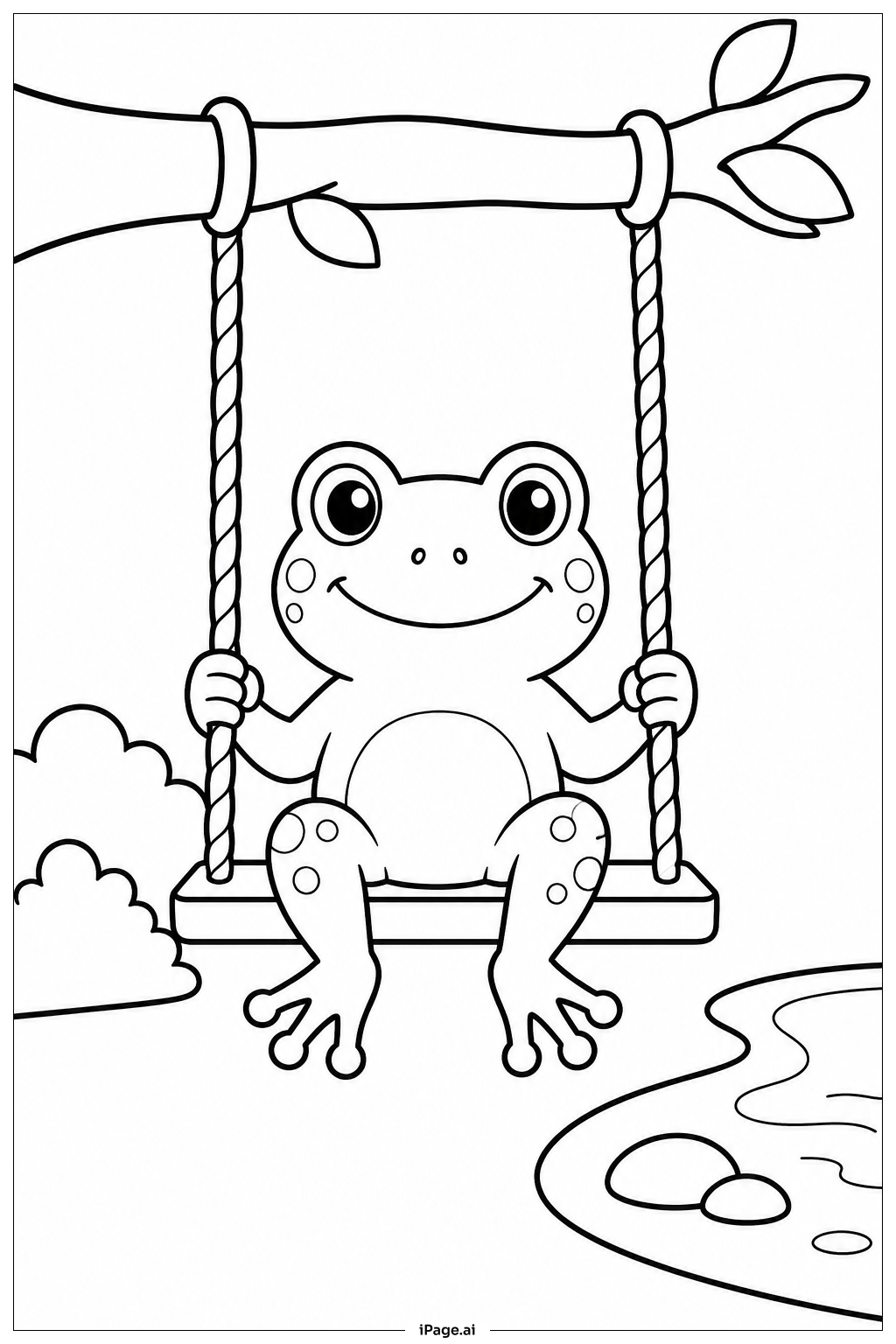
Coloring tips: How to color Frog On Swing coloring page well?
Start with the frog's body. Use a bright green for the main skin, and add a lighter yellow-green on the belly for contrast. The frog's eyes can be colored with golden yellow or orange for the irises, with small black pupils to make them pop. Use a warm brown for the swing seat and ropes to give them a natural wooden feel. The branch at the top can be a darker brown with hints of gray. Add soft green shades to the leaves above. If you want to add a background, try a light blue sky or a soft meadow scene in pale greens and yellows. Use darker green for shadows under the frog's limbs to add depth. Keep colors smooth and even in large areas, and feel free to add patterns like spots or stripes on the frog for extra fun.
Coloring challenges: Which parts are difficult to color and need attention for Frog On Swing coloring page?
• Frog's Overlapping Limbs: The frog's legs and hands overlap with the swing ropes and seat. This makes it tricky to color each part separately without accidentally bleeding into the wrong area. Take your time and use a fine-tipped tool to carefully outline each section before filling it in.
• Swing Ropes and Wooden Seat: The ropes are thin and run through the image vertically. Staying inside such narrow lines requires a steady hand. The wooden seat also has a small surface area with texture lines, which need careful shading to look realistic without becoming too dark or muddy.
• Frog's Large Eyes: The round eyes are an important focal point of the image. They have multiple layers, including the outer ring, the iris, and the small pupil. Coloring each layer neatly without smudging is a challenge, especially for younger colorists. Using lighter colors first and building up to darker ones helps.
• Body Shading and Smooth Gradients: The frog's rounded body looks best when shaded with gradients from light to dark green. Achieving a smooth transition without streaks or patches can be difficult, especially with crayons or markers. Colored pencils work best here for blending.
• Leaf Details at the Top: The leaves near the branch have small veins and layered shapes. Coloring them in different shades of green while keeping the veins visible requires patience and precise control. Avoid pressing too hard when filling in the base color so the vein lines remain clear.
Benefits of coloring books: Advantages of drawing Frog On Swing coloring page
Coloring this fun frog on a swing image offers many great benefits for kids and beginners alike. First, it helps build fine motor skills. Staying inside the lines while coloring the thin swing ropes and small details trains hand control and pencil grip. Second, it encourages creativity. Kids can choose any colors they like for the frog, the swing, and the background, making each finished page uniquely their own. Third, it supports focus and patience. Working through all the small sections, like the eyes, the ropes, and the leaves, teaches children to slow down and concentrate. Fourth, it introduces basic color theory in a playful way. Mixing light and dark greens for the frog's body helps young colorists understand shading and contrast naturally. Fifth, it provides emotional calm. The peaceful, playful scene of a happy frog swinging in nature creates a relaxing and joyful coloring experience. It is a great activity for winding down after a busy day. Overall, this image makes coloring both educational and enjoyable for children of all skill levels.