Coloring tips: How to color Science Solar System Map Scene coloring page well?
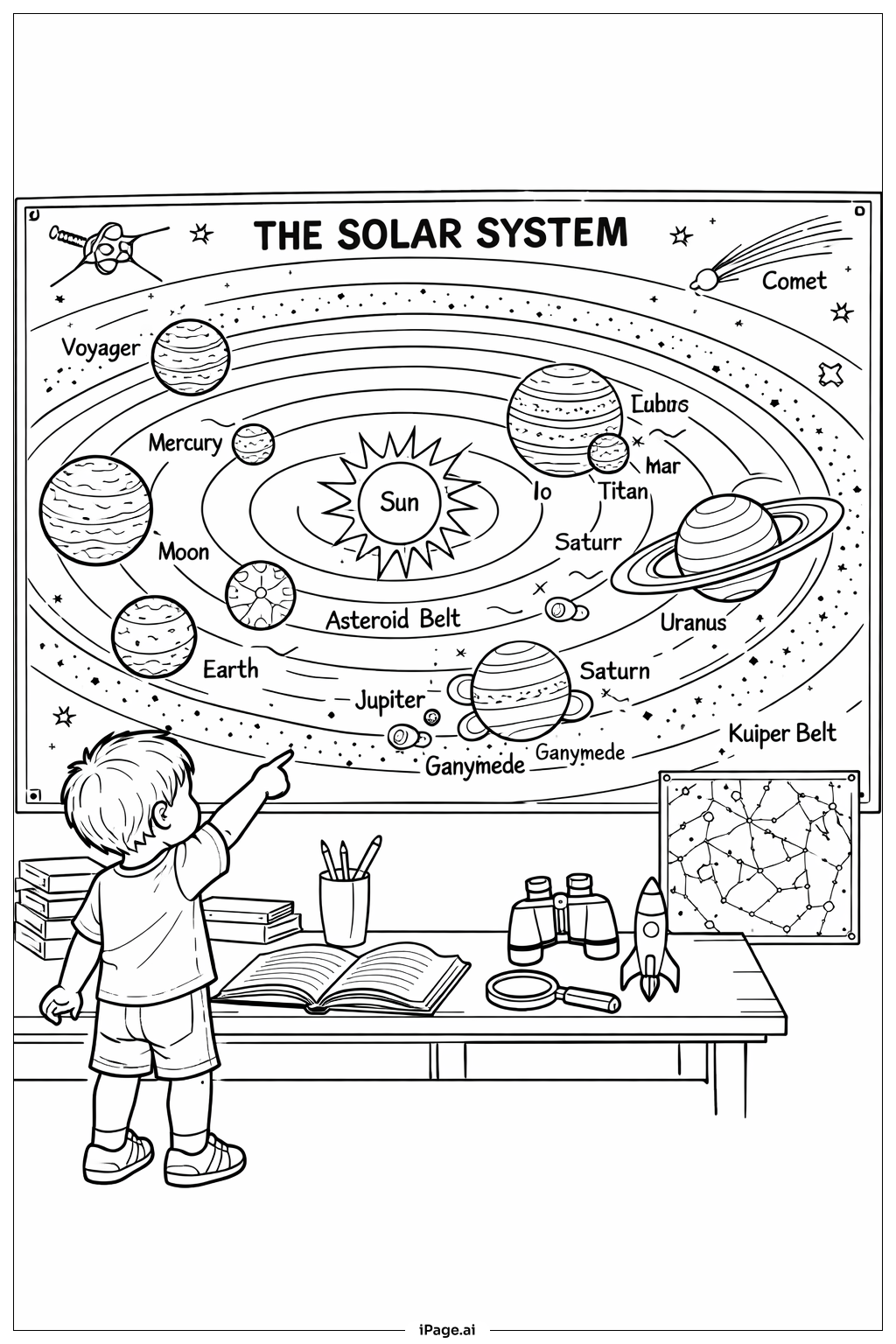
Start with the Sun at the center and use bright yellows and warm oranges to make it glow. For each planet, use colors inspired by real science — rocky brown and gray for Mercury, creamy yellow for Venus, blue and green for Earth, rusty red for Mars, swirling orange and white bands for Jupiter, golden yellow with pale rings for Saturn, icy blue-green for Uranus, and deep blue for Neptune. Use a dark navy or black for the space background, then add tiny white or yellow dots for stars. Comets can have bright white or icy blue tails. The asteroid belt can be colored in soft grays and browns. For older kids, try blending and shading to give planets a round, three-dimensional look. Younger kids can keep it simple by picking one bold color per planet. Have fun making each planet feel unique!
Coloring challenges: Which parts are difficult to color and need attention for Science Solar System Map Scene coloring page?
• Sun's Radiating Lines: The Sun sits at the center and has many thin lines spreading outward to show energy and light. Staying inside these narrow lines without overlapping into surrounding space takes a steady hand and a fine-tipped coloring tool. Younger colorists may find this part especially tricky.
• Planetary Size Differences: The planets vary greatly in size — from small Mercury to enormous Jupiter. Filling in tiny planets with detail requires careful control and a sharp pencil or thin marker, while larger planets like Jupiter and Saturn offer more space for blending and pattern work such as storm bands or cloud stripes.
• Saturn's Ring System: Saturn's rings are one of the most visually complex elements in this scene. They wrap around the planet in layered arcs and need to be colored in subtle gradients of gold, tan, and pale brown to look realistic. Keeping the rings distinct from the planet body without smudging is a real challenge.
• Orbital Path Lines: The curved orbital lines that mark each planet's path around the Sun are thin and closely spaced, especially near the inner planets. Coloring around them without accidentally covering them requires patience and precision, particularly when using broader markers or crayons.
• Deep Space Background: Filling the large dark background evenly with a deep navy or black while leaving stars and cosmic details visible is demanding. Pressing too hard can obscure fine star details, while pressing too lightly may result in a patchy, uneven finish. Working slowly in small sections helps achieve a clean, consistent result.
Benefits of coloring books: Advantages of drawing Science Solar System Map Scene coloring page
Coloring this solar system scene offers a rich mix of creative and educational rewards for kids of all ages. As children choose colors for each planet, they naturally absorb real facts about our solar system — connecting art with science in a meaningful way. This kind of learning through doing helps information stick far better than reading alone.
The wide variety of elements in this image, from the glowing Sun to tiny distant planets, gives colorists plenty of opportunities to practice different techniques. Kids build fine motor skills as they navigate orbital lines, small planet shapes, and intricate ring details. These small, controlled movements strengthen the hand muscles used in writing and drawing.
Focusing on a detailed scene like this also trains concentration and patience. Completing the full image gives children a real sense of accomplishment, boosting confidence and encouraging a growth mindset.
For older kids and teens, this image is a great way to explore color theory — experimenting with blending, shading, and creating depth to make planets look three-dimensional. It encourages creative thinking and personal expression, since no two finished pages will look exactly alike.
Overall, this coloring page makes science feel fun, accessible, and personal — a wonderful tool for both classroom learning and quiet creative time at home.