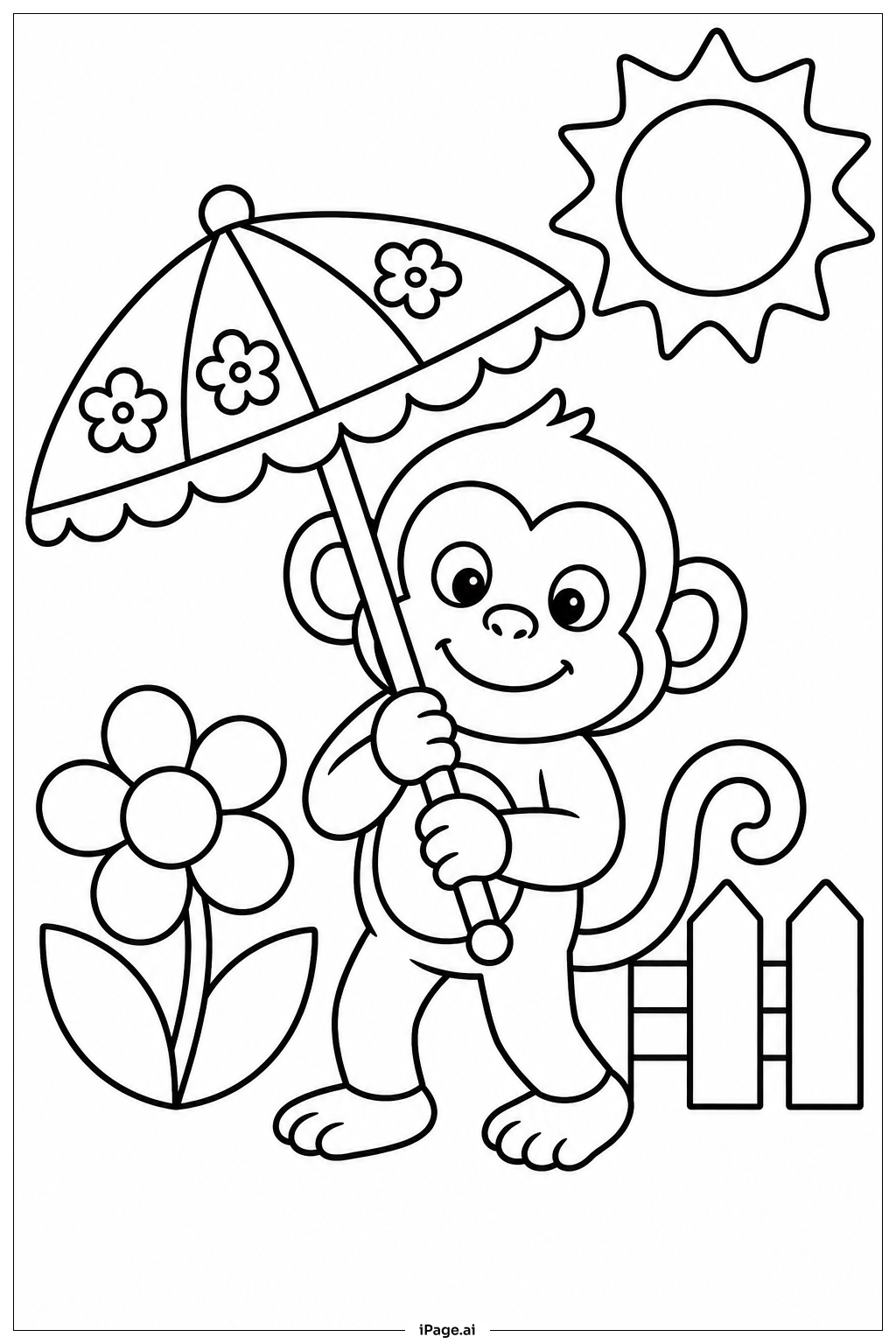
Coloring tips: How to color Monkey With Parasol coloring page well?
Start with the monkey's body and face. Use warm brown or tan shades for the fur, and a lighter peach or cream color for the face, ears, and belly. Give the eyes a dark brown or black fill, and add a pink blush to the cheeks for a friendly look. For the parasol, have fun with bright, cheerful colors. Try red, yellow, or purple for the canopy panels, and alternate shades to make the sections pop. The scalloped edges can be white or a contrasting color. Use a darker shade for the parasol handle. For the outfit, pick bold, fun colors like blue, green, or orange to make the monkey look stylish. Add light green or yellow to the background leaves to give the scene a tropical feel. Don't be afraid to mix colors and try your own combinations. This image is a great chance to explore shading by adding slightly darker tones along the edges of shapes to create depth.
Coloring challenges: Which parts are difficult to color and need attention for Monkey With Parasol coloring page?
• Parasol Panel Sections: The parasol canopy is divided into multiple curved panels with scalloped edges. Staying within each panel while keeping colors neat and consistent can be tricky, especially near the curved borders where sections meet. Take your time and use a fine-tipped tool for the edges before filling in the center of each panel.
• Monkey Fur Texture: The monkey's body has a soft, rounded form that benefits from smooth, even coloring. Achieving a natural fur look requires careful blending of light and shadow tones. Young colorists may find it hard to keep a consistent tone across larger areas like the back and arms without visible streaks.
• Small Facial Features: The monkey's face has small, closely spaced details like the eyes, nose, and smile. These tiny areas require a steady hand and a sharp, thin coloring tool. Accidentally coloring outside these small features can affect the monkey's expression and overall charm.
• Outfit and Body Boundary Lines: The monkey's clothing meets its fur at several points. Keeping the outfit colors clearly separated from the fur colors requires attention to detail, especially around the neckline, wrists, and waist where the two areas are close together.
• Background Leaves and Depth: The leaves and background elements overlap with the main character in some areas. Choosing colors that contrast well with the monkey and parasol without making the scene look cluttered is a real challenge. Using lighter, muted greens for the background helps keep the focus on the monkey in the foreground.
Benefits of coloring books: Advantages of drawing Monkey With Parasol coloring page
Coloring this Monkey With Parasol image offers a wonderful range of benefits for children and young artists. Working on the parasol panels helps develop precision and fine motor control, as kids practice staying within curved lines and small spaces. This kind of careful, focused work naturally improves hand-eye coordination over time. The playful scene sparks creativity and imagination. Children get to decide which colors to use for the fur, outfit, and parasol, making each finished page uniquely their own. This freedom of choice builds confidence and encourages self-expression. Focusing on a fun coloring task also provides a calming, screen-free activity that helps children unwind and relax. It teaches patience as they work through the different sections at their own pace. The variety of shapes in this image, from the round parasol canopy to the monkey's curved features, introduces kids to recognizing different forms and how colors can be used to highlight them. Overall, this image makes coloring both enjoyable and educational, blending artistic skill-building with pure, imaginative fun suitable for a wide range of ages.