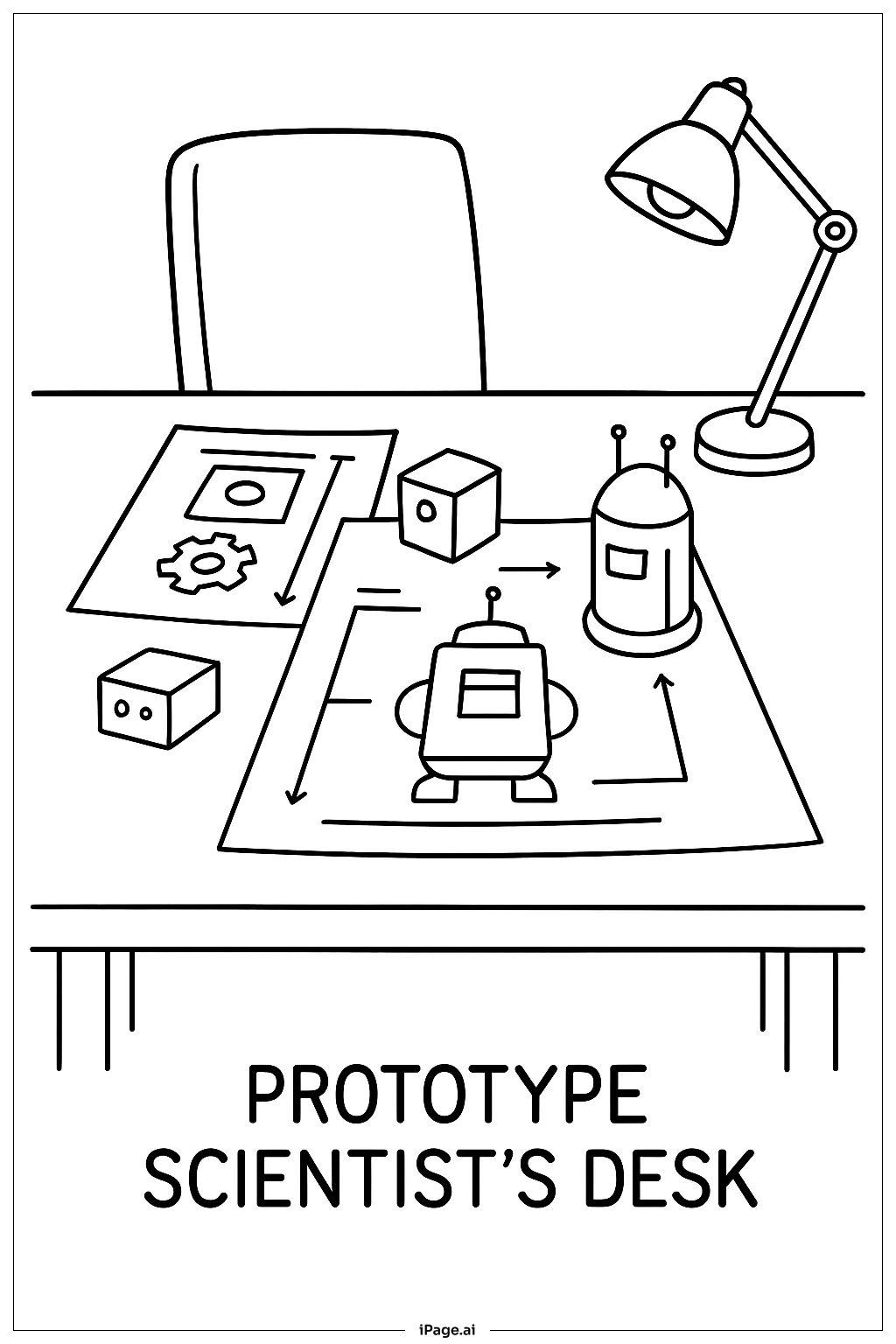
Coloring tips: How to color Prototype Scientist's Desk coloring page well?
Start with the desk surface using warm browns or grays to create a solid foundation. Color the microscope with metallic silver and gray tones, adding hints of gold for brass details. Make the test tubes and beakers exciting by using bright blues, greens, purples, and pinks for the liquids inside, suggesting different chemical experiments. The blueprint papers can be colored in light blue with white lines, or kept cream-colored. Use bright yellow or orange for safety goggles to make them stand out. The laptop screen could be light blue or green. Color the robotic arm with silver, gray, and touches of red or blue for wiring. Books can be various colors like red, blue, green, and brown. Add colored pencils in the holder using rainbow colors, and use orange, yellow, or green for the notebook covers.
Coloring challenges: Which parts are difficult to color and need attention for Prototype Scientist's Desk coloring page?
• Small Detailed Objects: The desk contains many tiny items like screws, nuts, bolts, pencils, and mechanical parts that require careful coloring within small spaces. Children may find it challenging to color these small elements without going outside the lines, requiring steady hand control and patience. Using fine-tipped coloring tools like colored pencils or thin markers will help achieve better precision in these tight areas.
• Overlapping Elements: Multiple objects overlap each other on the desk, such as papers laying over books, test tubes in front of beakers, and the robotic arm positioned among other equipment. This layering creates complex boundaries that can be confusing to color. Children need to carefully identify where one object ends and another begins, deciding which items are in front and which are behind to create proper depth and avoid color bleeding between different objects.
• Technical Equipment Details: The microscope, robotic arm, and laptop contain intricate mechanical and technical details like lenses, joints, hinges, screens, and buttons. These elements have multiple small parts and fine lines that challenge young colorists to maintain accuracy. Coloring these realistic scientific instruments requires attention to shading and dimension to make them look three-dimensional and authentic.
• Maintaining Color Organization: With so many different objects on one desk, it can be overwhelming to choose and organize colors effectively. Children must decide on a color scheme that makes each item distinct and recognizable while keeping the overall image harmonious and not too chaotic or visually confusing.
Benefits of coloring books: Advantages of drawing Prototype Scientist's Desk coloring page
Coloring this scientist's desk helps children develop fine motor skills and hand-eye coordination through the precise coloring of small detailed objects. It encourages focus and concentration as they work through the many different elements on the busy desk. This image sparks interest in science, technology, and invention, inspiring curiosity about how things work and what scientists do. Children learn to recognize scientific tools and equipment, expanding their vocabulary and knowledge about STEM fields. The complex composition teaches planning and decision-making skills as they choose which colors work well together and in what order to color overlapping objects. It also builds patience and persistence since completing this detailed scene takes time and careful effort, giving a strong sense of accomplishment when finished.