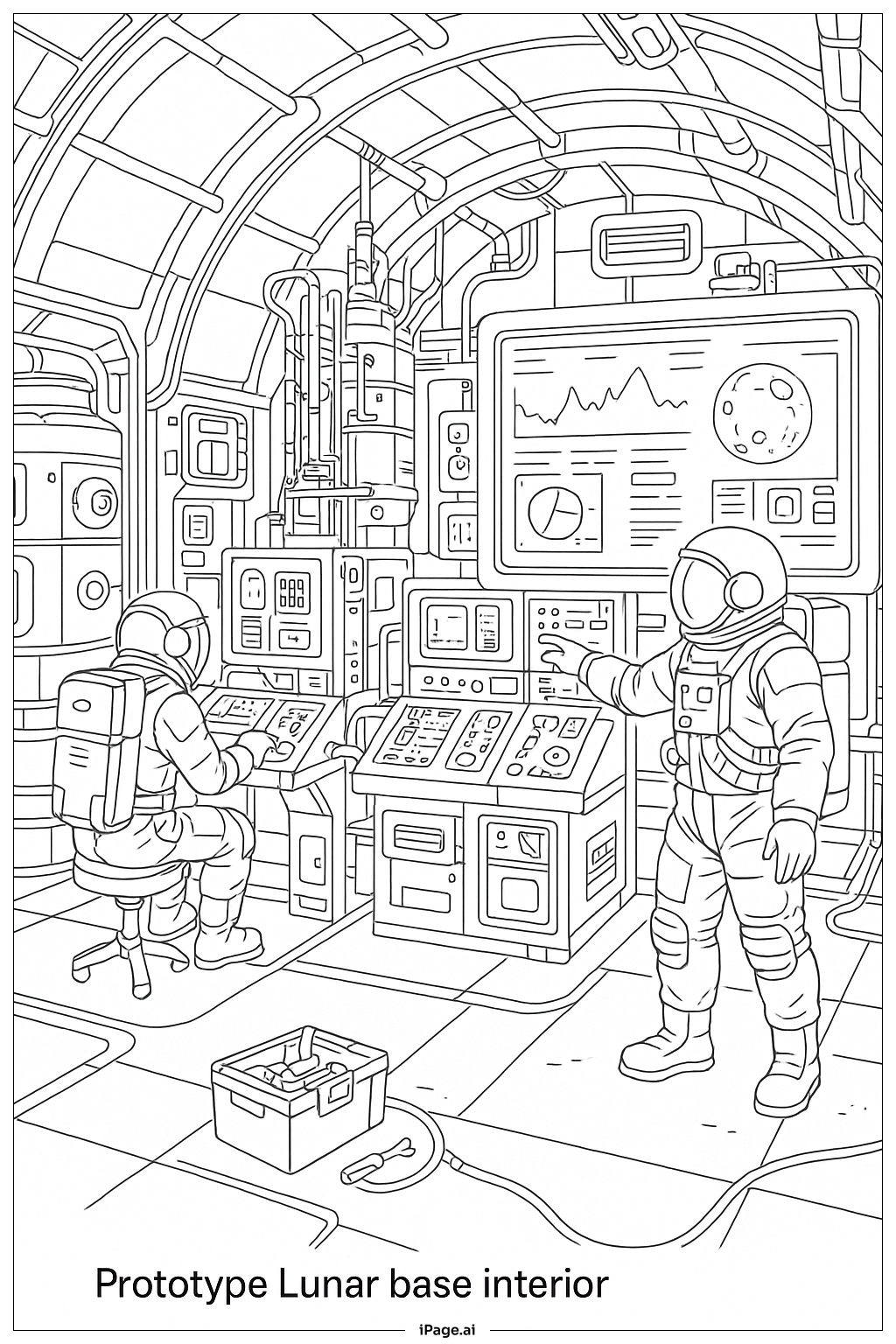
Coloring tips: How to color Prototype Lunar Base Interior coloring page well?
Start with the walls using light grays or soft blues to create that metallic spacecraft feel. The ceiling panels can be colored in shades of white, silver, or pale blue to represent advanced materials. Use darker grays or black for the floor grating and technical details to add depth and contrast. The circular modules and control panels are perfect for adding pops of color - try blues, greens, or reds for display screens and indicator lights. Color the windows dark blue or black to represent the darkness of space, perhaps adding tiny white dots for stars. Mechanical equipment can be rendered in metallic colors like bronze, copper, or steel gray. Consider using colored pencils for subtle shading to make the curved surfaces look three-dimensional and realistic.
Coloring challenges: Which parts are difficult to color and need attention for Prototype Lunar Base Interior coloring page?
• Perspective and Depth: The corridor design uses complex perspective lines that converge toward the center, creating a tunnel effect. Maintaining consistent color intensity and shading along these curved surfaces requires careful attention to make the space look three-dimensional rather than flat. Children may find it challenging to understand which areas should be lighter or darker to achieve realistic depth.
• Intricate Technical Details: The image contains numerous small mechanical components, control panels, circular modules, and geometric patterns throughout the walls and floor. These tiny spaces require precision coloring and a steady hand. Younger children might struggle to stay within the lines of these detailed technical elements, while older colorists will need patience to fill each small section without smudging.
• Repetitive Pattern Consistency: The ceiling panels, wall modules, and floor grating feature repeating geometric patterns that need consistent coloring to look professional. Maintaining the same color scheme and intensity across multiple identical elements throughout the image can be tedious and requires planning before starting.
• Distinguishing Different Surfaces: The base interior includes various materials and surfaces - smooth walls, textured floors, glass windows, and metal equipment. Creating visual distinction between these different surfaces through color choices and shading techniques requires thoughtful planning and understanding of how different materials reflect light in a space environment.
Benefits of coloring books: Advantages of drawing Prototype Lunar Base Interior coloring page
Coloring this Prototype lunar base interior offers wonderful educational benefits by sparking interest in space exploration, science, and engineering. Children learn about how astronauts might live and work on the moon while developing their understanding of perspective and three-dimensional space. The technical details help improve fine motor skills and hand-eye coordination as they carefully color small components. The repetitive patterns teach patience and consistency, while the complex architectural elements encourage planning and decision-making about color schemes. This image also promotes problem-solving skills as children figure out how to use shading and color contrast to make different surfaces and materials look realistic. The futuristic theme stimulates creativity and imagination about future space missions, potentially inspiring interest in STEM subjects and space science careers.