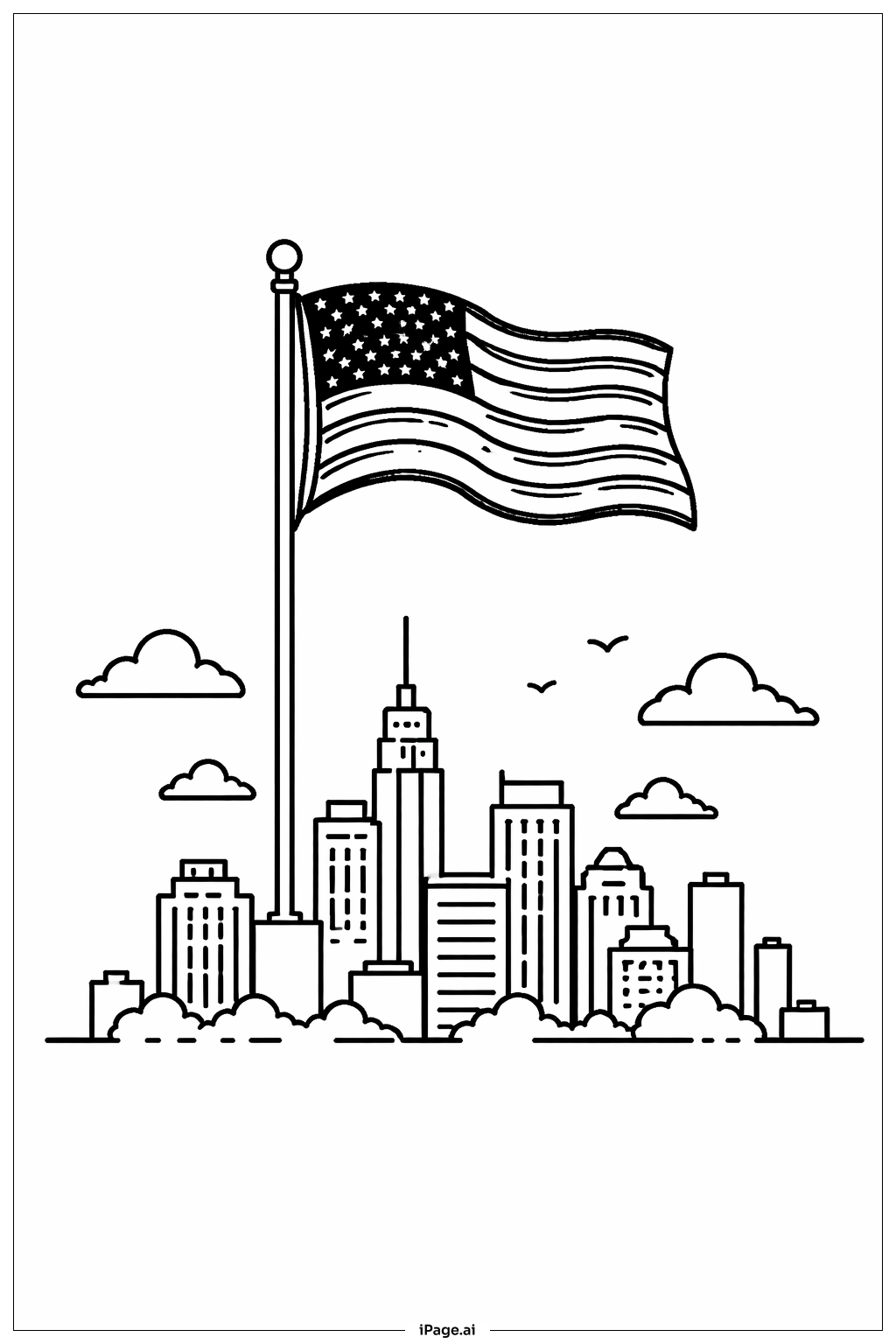
Coloring tips: How to color American Flag Above City Skyline coloring page well?
For the American flag, use the traditional colors: bright red for the stripes, deep blue for the canton, and leave the stars white or use a light cream shade. The city skyline offers wonderful creative opportunities. Try using various shades of gray, blue, and brown for different buildings to create depth and dimension. Consider making buildings in the foreground darker and those in the background lighter to show distance. You can add golden or yellow tones to some windows to suggest sunlight reflecting off the glass. The sky can be colored with soft blues, or try sunset colors like orange, pink, and purple for a dramatic effect. Use colored pencils or markers to add shading on one side of the buildings to show where shadows fall.
Coloring challenges: Which parts are difficult to color and need attention for American Flag Above City Skyline coloring page?
• Flag Stripes and Stars: The American flag contains 13 alternating stripes and 50 small stars that require careful attention. Staying within the lines of each narrow stripe can be challenging, especially where the fabric folds. The stars are tiny and numerous, demanding patience and precision to color the surrounding blue field while keeping each star clean and visible.
• Building Windows and Details: The city skyline features multiple buildings with dozens of small rectangular windows arranged in grids. Coloring each window individually while maintaining consistency is time-consuming and requires steady hand control. Young children may find the repetitive pattern tedious, while the small spaces can be difficult to fill neatly without going over the lines.
• Fabric Folds and Movement: The flag's rippling motion creates curved sections and overlapping folds that need different shading to look realistic. Understanding where to place darker tones for shadows and lighter tones for highlights requires some artistic judgment. Blending colors smoothly on these curved surfaces is more advanced than coloring flat areas.
• Creating Depth and Perspective: To make the cityscape look three-dimensional, colorists need to use various tones and shades for different buildings. Buildings in front should appear darker or more detailed, while those in back should be lighter. This concept of atmospheric perspective can be difficult for younger children to grasp and execute effectively.
• Coordinating Multiple Elements: Balancing colors between the bold flag in the foreground and the detailed cityscape behind requires planning. The flag should remain the focal point while the buildings complement rather than compete with it. Choosing a harmonious color palette that works for both elements takes thought and color theory knowledge.
Benefits of coloring books: Advantages of drawing American Flag Above City Skyline coloring page
Coloring this patriotic scene helps children learn about American symbols and national pride while developing important skills. The flag's stripes and stars teach counting and pattern recognition as kids work through the repeated elements. The detailed cityscape improves fine motor control and hand-eye coordination through precise coloring of small windows and architectural features. This image encourages patience and focus, as completing all the details requires sustained concentration. Children practice decision-making by choosing appropriate colors for different buildings and determining how to create depth. The combination of geometric shapes in the buildings and flowing curves in the flag helps kids understand different forms and how to color them. This coloring page also sparks conversations about cities, architecture, patriotism, and American history, making it both educational and fun.