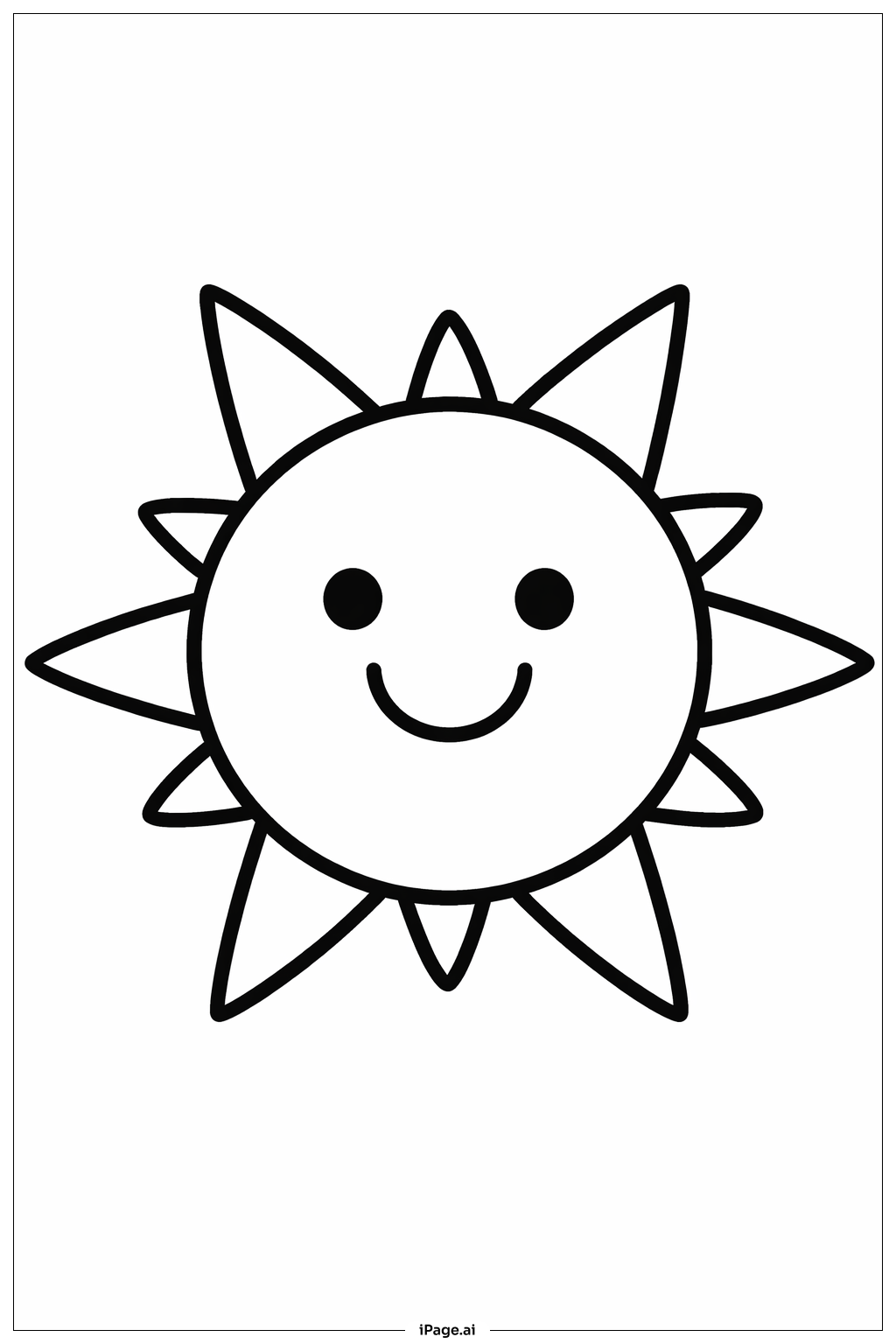
Coloring tips: How to color Sun With Two Big Rays coloring page well?
Start by choosing a bright, warm yellow or golden orange for the main circular body of the sun to capture its radiant energy. The two big rays can be colored in a gradient effect, starting with bright yellow at the base and transitioning to lighter yellow or even white at the tips to show how light spreads outward. For the facial features, use darker shades like brown, orange, or even red to make the eyes and smile stand out clearly against the bright face. Consider adding a soft peachy color to the cheeks for extra warmth and personality. You can also experiment with unconventional colors like pink, purple, or rainbow hues to create a more imaginative, artistic sun. Adding small details like tiny sparkles or highlights with white or light yellow can make your sun appear even more radiant and magical.
Coloring challenges: Which parts are difficult to color and need attention for Sun With Two Big Rays coloring page?
• Large Area Coverage: The sun's circular face is a relatively large space that requires consistent coloring to avoid streaks or uneven patches. Young children may find it challenging to maintain steady pressure and color distribution across this entire area without leaving white spots or creating darker areas where strokes overlap.
• Ray Coloring Technique: The two big rays offer an opportunity for creative shading or gradient effects, but achieving smooth color transitions from darker to lighter tones requires practice and patience. Children need to blend colors carefully or use varying pressure to create depth, which can be difficult for those still developing fine motor control.
• Facial Feature Precision: The eyes and smile are small details within the larger sun face. Coloring these features neatly without going outside the lines requires careful hand control and concentration. Younger artists might struggle to keep their coloring tool steady when working on these smaller elements, especially if they want to use different colors for each feature.
• Color Selection Balance: Choosing colors that complement each other while making all parts of the sun visible can be tricky. If children use too similar shades for the face, rays, and features, the different elements may blend together and lose definition. Learning to select contrasting colors that still feel harmonious is an important skill that develops with practice.
Benefits of coloring books: Advantages of drawing Sun With Two Big Rays coloring page
Coloring this cheerful sun design helps children develop important foundational skills. The large circular shape is perfect for practicing smooth, controlled coloring strokes and building hand strength. The two big rays encourage symmetrical thinking and color matching as children decide whether to make them identical or create variety. Working on the facial features enhances fine motor precision and hand-eye coordination as little hands carefully navigate smaller spaces. This simple yet engaging design builds confidence in young artists because it is achievable and rewarding to complete. The friendly sun theme also provides opportunities to discuss warmth, happiness, and nature, connecting art to emotional learning. Additionally, choosing colors for the sun encourages decision-making and creative expression, allowing each child to make the image uniquely their own. The straightforward design makes it accessible for beginners while still offering room for creative experimentation with shading and color combinations.



