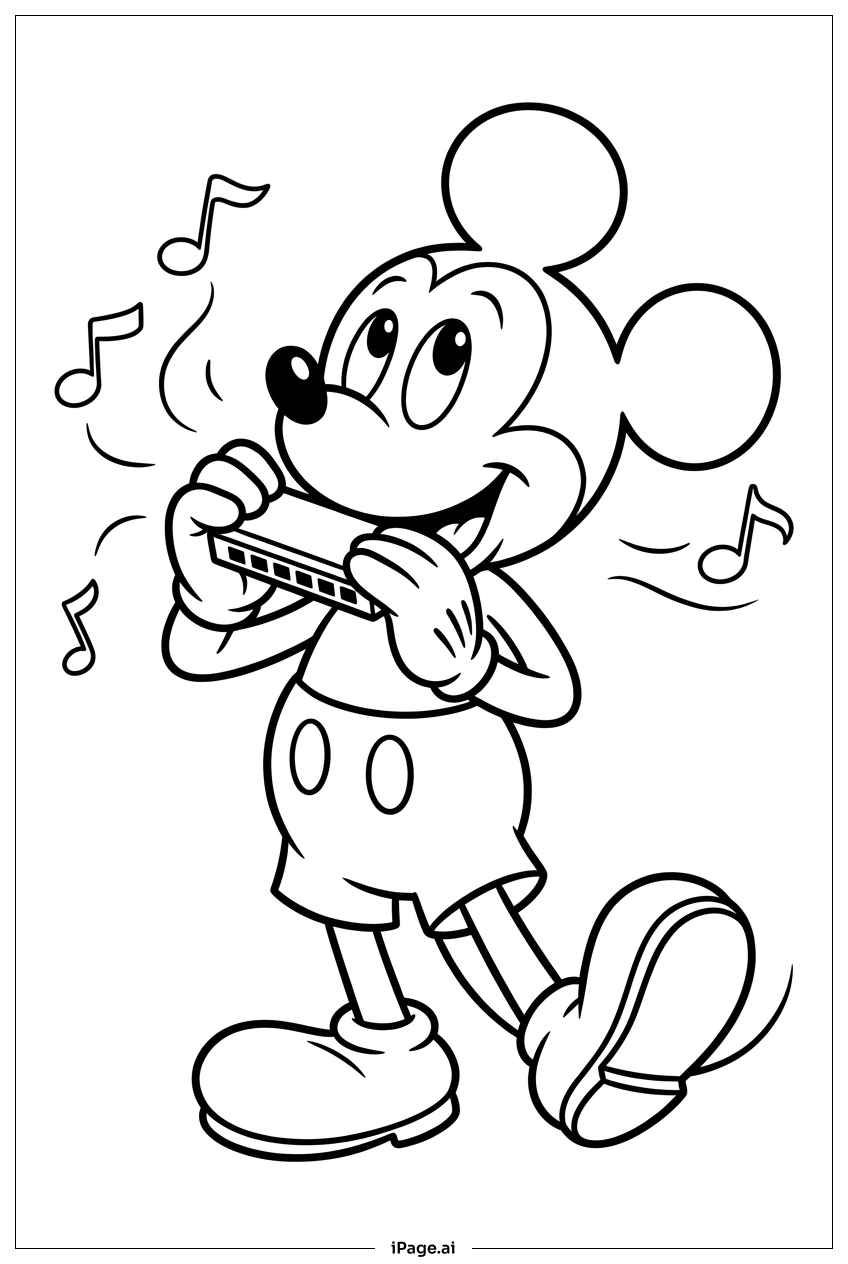
Coloring tips: How to color Mickey Mouse Playing a Happy Harmonica Tune coloring page well?
Start with Mickey's iconic colors: black for his body and ears, and a peachy skin tone for his face. His shorts should be bright red, and the buttons can be yellow or gold. Use white for his gloves to make them stand out. The harmonica can be silver, blue, or any metallic color you prefer. For the musical notes floating around Mickey, try using multiple bright colors like yellow, orange, pink, and light blue to show the joyful energy of the music. You can add a soft yellow or light orange glow around the notes to make them look like they're shimmering. Consider using colored pencils for smooth blending on Mickey's face and body, while markers work great for bold, solid colors on his outfit. Add shading with darker tones to give depth to his gloves and face.
Coloring challenges: Which parts are difficult to color and need attention for Mickey Mouse Playing a Happy Harmonica Tune coloring page?
• Small Musical Notes: The floating musical notes scattered throughout the image are quite small and require careful coloring to stay within the lines. Young children may find it challenging to color these tiny shapes without going outside the boundaries. Using fine-tipped markers or sharp colored pencils will help achieve clean results in these delicate areas.
• Glove Details and Fingers: Mickey's gloves have distinct finger sections and curved lines that require precision. The rounded shapes of each finger and the separation between them need attention to detail. Keeping each finger uniformly colored while respecting the black outlines can be tricky, especially where fingers overlap or curve around the harmonica.
• Harmonica Structure: The harmonica features small rectangular holes and fine details that represent the reeds and mouthpiece. These repetitive small sections require patience and steady hand control. Colorists need to decide whether to color each hole individually or treat the harmonica as one solid object, and maintaining consistency across these tiny spaces can be demanding.
• Face and Expression Details: Mickey's facial features include his eyes, nose, and wide smile, all of which have curved lines and small spaces. Coloring around the eyes while keeping the white highlights bright, and filling in the mouth area without disturbing the tooth and tongue details requires careful work and good fine motor skills.
Benefits of coloring books: Advantages of drawing Mickey Mouse Playing a Happy Harmonica Tune coloring page
Coloring this Mickey Mouse harmonica page helps children develop fine motor skills through the detailed work required for small musical notes and facial features. It encourages creativity as kids choose colors for the musical notes and decide how to make the scene come alive. This page introduces children to musical concepts in a fun way, connecting visual art with music appreciation. Working on Mickey's familiar and friendly character builds confidence, especially for younger colorists who recognize and love this classic character. The combination of larger areas like Mickey's body and smaller details like the harmonica offers a balanced challenge suitable for various skill levels. Completing this page provides a sense of accomplishment and can spark interest in both art and music, making it an engaging educational activity.