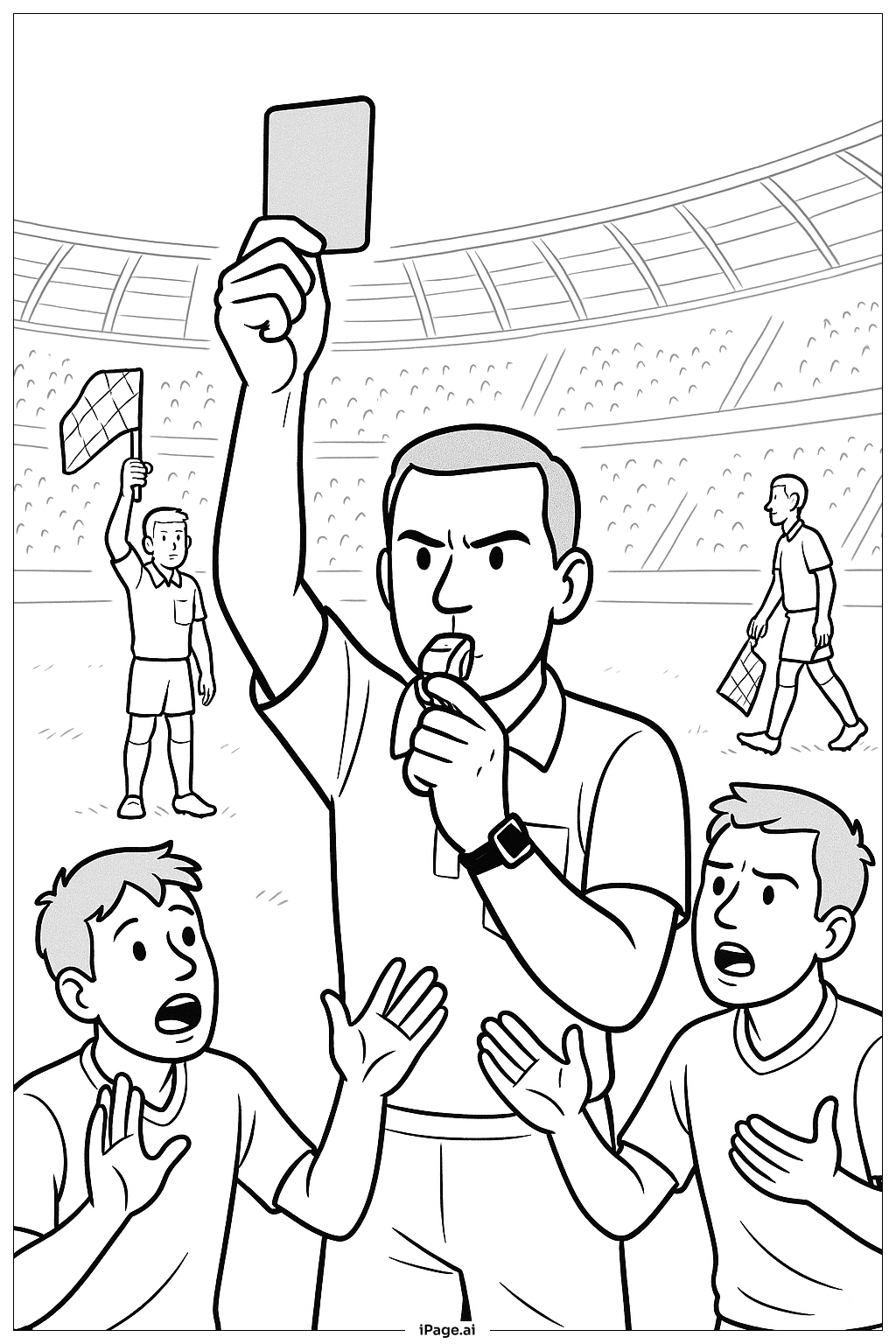
Coloring tips: How to color Referee Whistle Football Decision coloring page well?
Start with the referee's uniform. Use black and white stripes — a classic referee look that kids will recognize right away. Add a bright yellow or red badge on the chest for contrast. Color the skin tone naturally, and use a warm color like tan or brown for the referee's face and hands. The whistle can be silver or gold to make it stand out. Use green for the football field in the background, and light brown or tan for the football on the grass. The goal posts can be yellow or white. Try using darker shades around the edges of clothing to create a sense of depth. Use lighter tones for the sky in the background — pale blue works great. Encourage young colorists to be bold with their choices and have fun making the scene feel alive and exciting.
Coloring challenges: Which parts are difficult to color and need attention for Referee Whistle Football Decision coloring page?
• Referee Uniform Stripes: The black and white stripes on the referee's shirt can be tricky to color neatly. The lines are close together, so staying inside each stripe without smudging into the next one takes patience and a sharp pencil or fine-tip marker. Younger colorists may find this part especially challenging.
• Small Whistle Details: The whistle is a small object with tiny parts, including the mouthpiece, the body, and a cord or chain. Coloring such a small item without going outside the lines requires careful control. A thin marker or a sharpened colored pencil works best for this area.
• Raised Arm and Hand Pose: The referee's raised arm and outstretched hand involve multiple overlapping shapes — the sleeve, the wrist, and the fingers. Getting each part colored separately without blending them together can be difficult, especially where the hand meets the cuff of the uniform.
• Background Field and Goal Posts: The background includes a football field with yard lines and upright goal posts. These are thin and geometric shapes. Keeping the green of the field smooth and even while carefully outlining the goal posts in a different color takes steady hands and attention to detail.
• Layering Shadows and Depth: To make the image look three-dimensional, colorists need to add shading — darker tones on one side of the body and lighter tones on the other. This technique of layering colors is a fun challenge for older kids and beginners who want to level up their coloring skills.
Benefits of coloring books: Advantages of drawing Referee Whistle Football Decision coloring page
Coloring this referee and football scene offers a wide range of benefits for kids of all ages. First, it helps build fine motor skills. Staying inside the lines of the striped uniform and small whistle details trains hand control and precision — skills that are useful in writing and drawing too. Second, it encourages focus and concentration. The image has lots of details that require attention, helping children practice sitting still and working carefully toward a finished goal. Third, it sparks an interest in sports and fairness. As kids color the referee, they can learn about the role of officials in football — how rules keep the game fair and safe for everyone. This can open up great conversations between kids and parents or teachers about sportsmanship and respect. Fourth, it boosts creativity. Choosing colors for the field, the uniform, and the background gives children the freedom to express themselves and make the scene their own. Finally, completing the page builds confidence. Finishing a detailed coloring page gives kids a real sense of achievement and pride in their work.