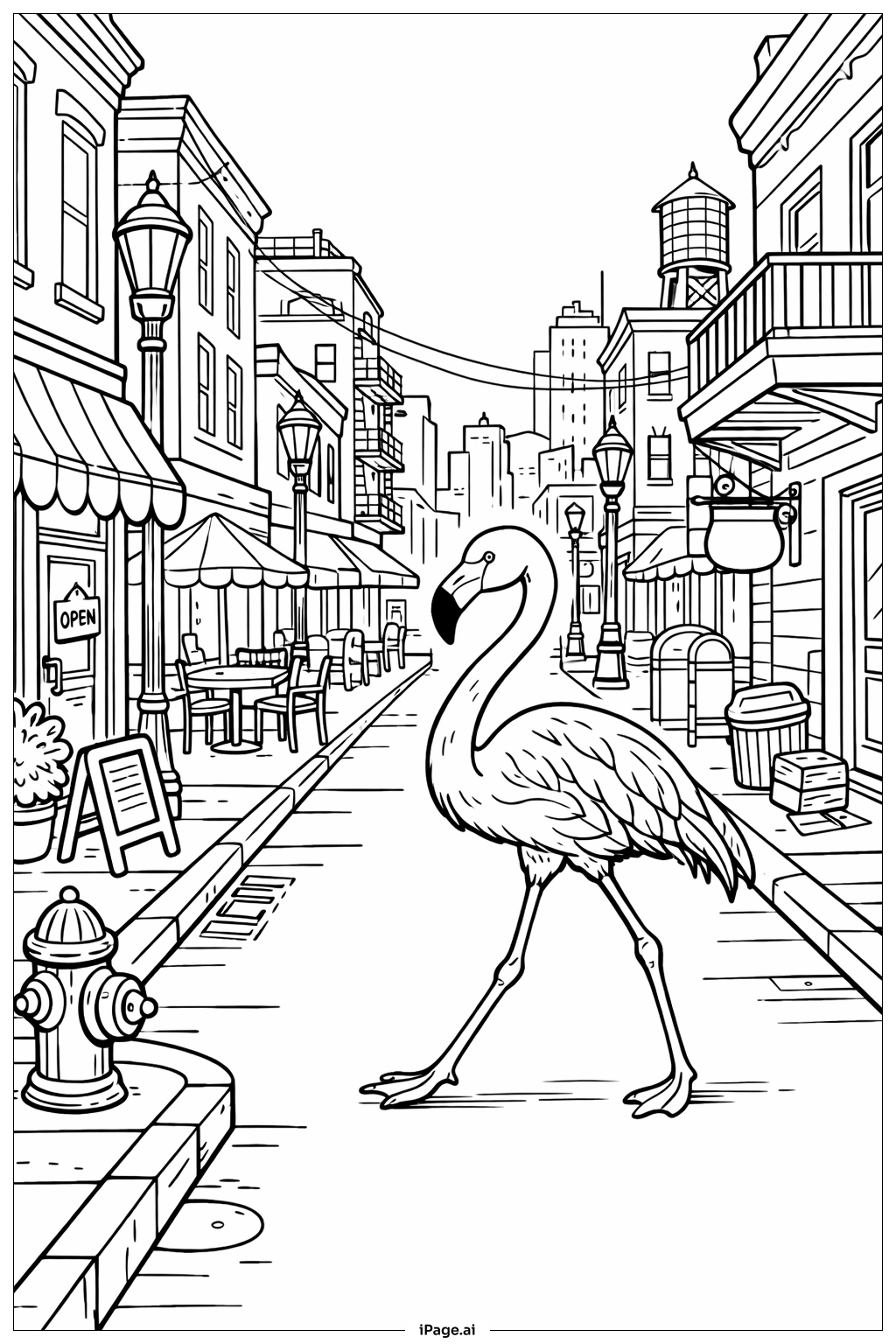
Coloring tips: How to color Flamingo City Street Scene coloring page well?
Start with the flamingo as your focal point. Use vibrant pink shades for the body, blending from deeper coral pink on the wings to lighter peachy pink on the chest and neck. The beak should be colored with orange at the tip and black at the base, staying true to the flamingo's natural appearance. For the legs, choose a warm peachy-orange tone. The city buildings offer wonderful opportunities for creativity—try using grays, browns, and tans for a realistic urban feel, or go bold with colorful buildings in blues, yellows, and greens. Add brick red or terracotta for building details. The street and sidewalk can be colored in gray or cement tones, while you might add touches of green for any plants or trees. Consider using colored pencils for smooth blending on the flamingo's feathers and markers for the bold architectural elements.
Coloring challenges: Which parts are difficult to color and need attention for Flamingo City Street Scene coloring page?
• Flamingo Body Shading: The flamingo's curved body requires careful color blending to create a three-dimensional appearance. The rounded form needs gradient techniques, transitioning from darker pink along the edges to lighter tones in the center where light naturally hits. Young colorists may find it challenging to maintain smooth transitions without creating harsh lines or uneven patches, especially around the wing area where feathers overlap.
• Thin Leg Precision: The flamingo's characteristically long, thin legs present a significant challenge for fine motor control. These narrow areas require steady hands and precise coloring to stay within the lines without the color bleeding into surrounding spaces. Children may struggle to maintain consistent color intensity along the entire length without gaps or over-coloring into the street background.
• Building Details and Windows: The city buildings feature multiple small windows, doors, and architectural elements that demand attention to detail and patience. Each window requires careful coloring within tiny spaces, and maintaining pattern consistency across multiple windows tests concentration skills. Deciding on color schemes for different buildings while keeping the overall scene harmonious adds another layer of complexity.
• Depth and Perspective: Creating a sense of distance between the foreground flamingo and background buildings requires understanding of color intensity and shading techniques. Buildings farther away should appear lighter or less saturated, while closer elements need bolder colors. This concept of atmospheric perspective can be difficult for younger artists to grasp and execute effectively.
Benefits of coloring books: Advantages of drawing Flamingo City Street Scene coloring page
Coloring this whimsical flamingo city scene offers numerous developmental benefits for children. It enhances fine motor skills and hand-eye coordination through the precise work required for the flamingo's thin legs and small building details. The image encourages creativity and imagination by presenting an unusual scenario—a tropical bird in an urban setting—that sparks storytelling and creative thinking about how this situation came to be. Working with the various elements helps children practice focus and patience, especially when coloring multiple similar structures like building windows. The scene introduces concepts of perspective and spatial relationships as children consider foreground and background elements. Color theory skills develop as young artists choose harmonious color schemes for buildings while making the flamingo stand out as the main subject. Additionally, this page provides a gentle introduction to both wildlife and urban environments, combining natural science with city architecture in an engaging, approachable way that builds visual literacy and observational skills.



