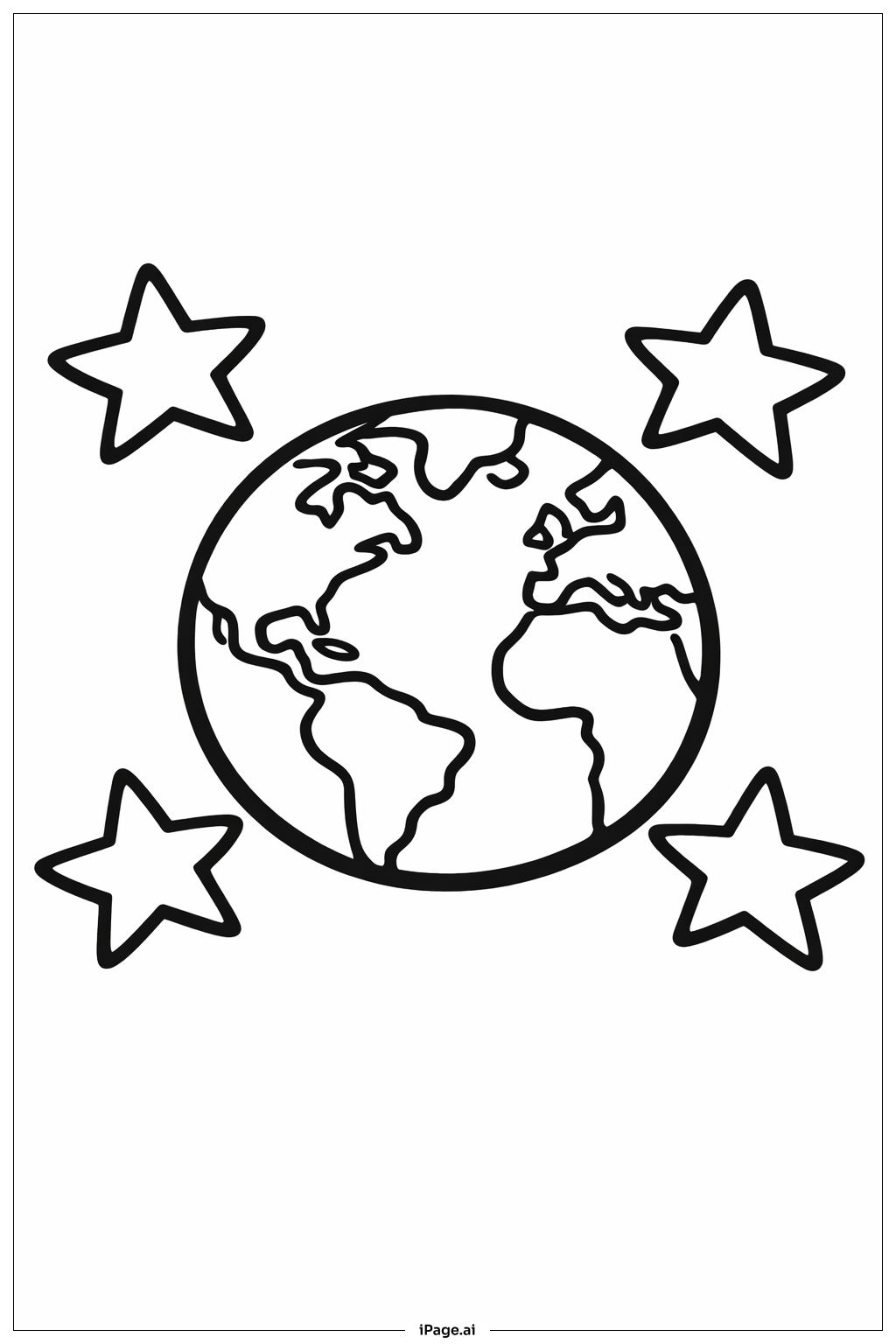
Coloring tips: How to color Earth With Stars coloring page well?
For Earth, use blues and greens as your primary colors. Apply different shades of blue for the oceans, from deep navy in the deeper waters to lighter turquoise near coastlines. Color the continents with various shades of green and brown, adding yellows for desert regions if you wish. You can add white highlights to the polar ice caps at the top and bottom of the globe. For the stars, try using bright yellows, whites, or even metallic gold and silver if available. Consider coloring some stars in warm tones like yellow and orange, while others could be cooler blues and whites to create variety. The background space can be colored in deep blues, purples, or black to make the Earth and stars stand out beautifully. Add gradients to create depth and dimension.
Coloring challenges: Which parts are difficult to color and need attention for Earth With Stars coloring page?
• Continental Details: The continents feature intricate coastlines with small islands, peninsulas, and irregular borders that require careful coloring within tight spaces. Young children may find it challenging to stay within these detailed boundaries, especially around archipelagos and coastal regions with many inlets.
• Curved Latitude and Longitude Lines: The grid lines that wrap around the spherical Earth create numerous small segments that need individual attention. Maintaining consistent colors while navigating these curved divisions can be tricky, and the intersecting lines form small shapes that require precision and patience to fill without crossing boundaries.
• Creating Depth with Stars: The varying sizes of stars present a challenge in making the scene look three-dimensional. Deciding which colors and shading techniques to use for foreground versus background stars requires planning. Smaller stars may be difficult to color neatly without the color bleeding into surrounding areas.
• Ocean Shading and Blending: To make the Earth look realistic and three-dimensional, the oceans benefit from gradient shading that shows the curve of the planet. Creating smooth color transitions from light to dark blue requires blending skills that may be challenging for beginners.
• Color Coordination: Balancing the colors between Earth, stars, and space background while ensuring each element stands out requires thoughtful color selection and contrast awareness.
Benefits of coloring books: Advantages of drawing Earth With Stars coloring page
Coloring this Earth with stars page offers wonderful educational benefits alongside creative development. Children learn about geography as they identify and color different continents and oceans, fostering global awareness and spatial understanding. The activity promotes fine motor skills development through the precise coloring required for detailed coastlines and small stars. It encourages planning and decision-making as young artists choose color schemes and shading techniques. The space theme sparks curiosity about astronomy, science, and our planet's place in the universe. This coloring page also teaches patience and focus, as completing the intricate details requires sustained concentration. Children practice color theory by experimenting with complementary colors for Earth and space, learning how contrast makes elements stand out. The meditative nature of coloring promotes relaxation and stress relief, while the accomplishment of finishing such a detailed piece builds confidence and self-esteem.