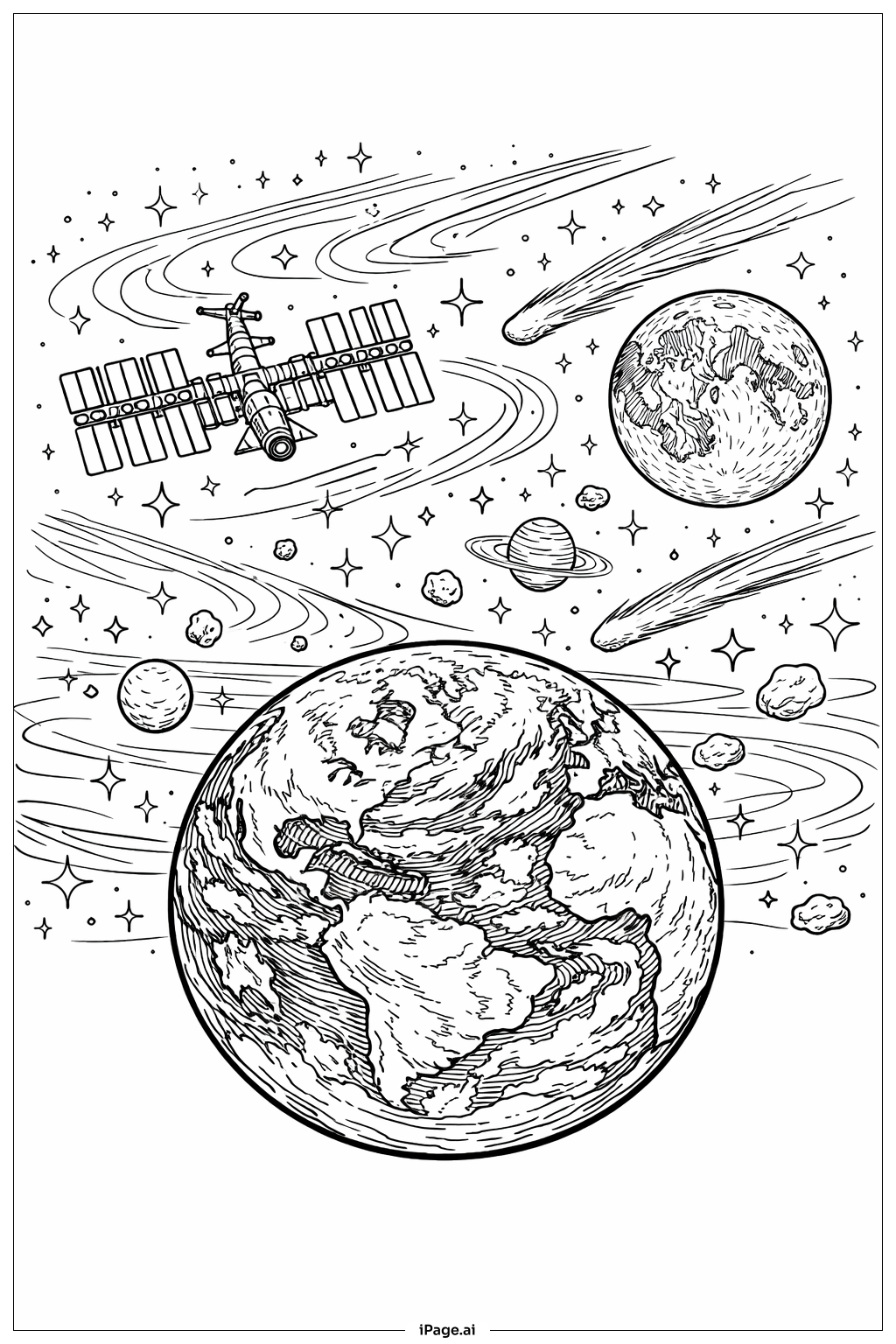
Coloring tips: How to color Earth In A Detailed Space Scene coloring page well?
Start with Earth as your focal point. Use blues and greens for the oceans and continents, adding white for cloud coverage. The surrounding space should be deep blues, purples, or black to create contrast. Color the Moon in soft grays and whites to show its cratered surface. For other planets, choose from oranges, reds, yellows, or browns depending on their size and position. Make shooting stars bright white or yellow with colorful trailing tails in blues, pinks, or purples. Asteroids can be gray or brown with darker shadowing. Color the sun in vibrant yellows and oranges with lighter shades radiating outward. Use silver or white for distant stars, varying their sizes to add depth. Consider using metallic or glitter pens for stars and cosmic dust to create a magical effect.
Coloring challenges: Which parts are difficult to color and need attention for Earth In A Detailed Space Scene coloring page?
• Planetary Details: Coloring Earth requires careful attention to geographical features, with small landmasses and ocean areas that need different shades of blue and green. Maintaining consistency across continents while showing variation between different land regions challenges young colorists to think about realistic earth tones versus creative interpretations.
• Space Depth and Layers: Creating a sense of depth in space scenes is challenging because you need to use darker colors in the background while keeping foreground objects bright and visible. Blending dark blues and purples for the space backdrop without making it look flat requires patience and possibly layering techniques that younger children may find difficult.
• Multiple Celestial Objects: The scene contains many different planets, stars, asteroids, and the Moon, each requiring different color schemes and techniques. Coordinating colors across all these elements while keeping each one distinct and ensuring they work together as a cohesive scene requires planning and color theory knowledge that may be advanced for beginners.
• Small Detailed Elements: Stars, space debris, and distant objects are small and numerous throughout the image. Coloring these tiny elements without going outside the lines demands fine motor control and patience. The shooting stars with their trailing tails require steady hands and gradient techniques to achieve a realistic glowing effect.
• Light and Shadow Effects: Showing how the sun illuminates Earth and other objects requires understanding where light would naturally fall and using lighter and darker shades accordingly. Creating realistic shadows on planets and highlighting areas that face the sun adds complexity that intermediate to advanced colorists will find appropriately challenging.
Benefits of coloring books: Advantages of drawing Earth In A Detailed Space Scene coloring page
Coloring this space scene offers wonderful educational benefits while developing important skills. Children learn about astronomy and our solar system by engaging with Earth, the Moon, planets, and stars in a hands-on creative way. This reinforces science concepts through art. The detailed elements improve fine motor skills and hand-eye coordination as young artists carefully color within lines and navigate small spaces. The variety of objects teaches color theory, as children experiment with complementary colors for planets against dark space and learn how to create contrast and depth. This complex scene also builds concentration and patience, as completing it requires sustained focus over time. The astronomical theme sparks curiosity about space exploration and science, potentially inspiring future interests in STEM fields. Finally, creating a beautiful universe fosters pride and confidence in artistic abilities while providing a calming, meditative activity that reduces stress.