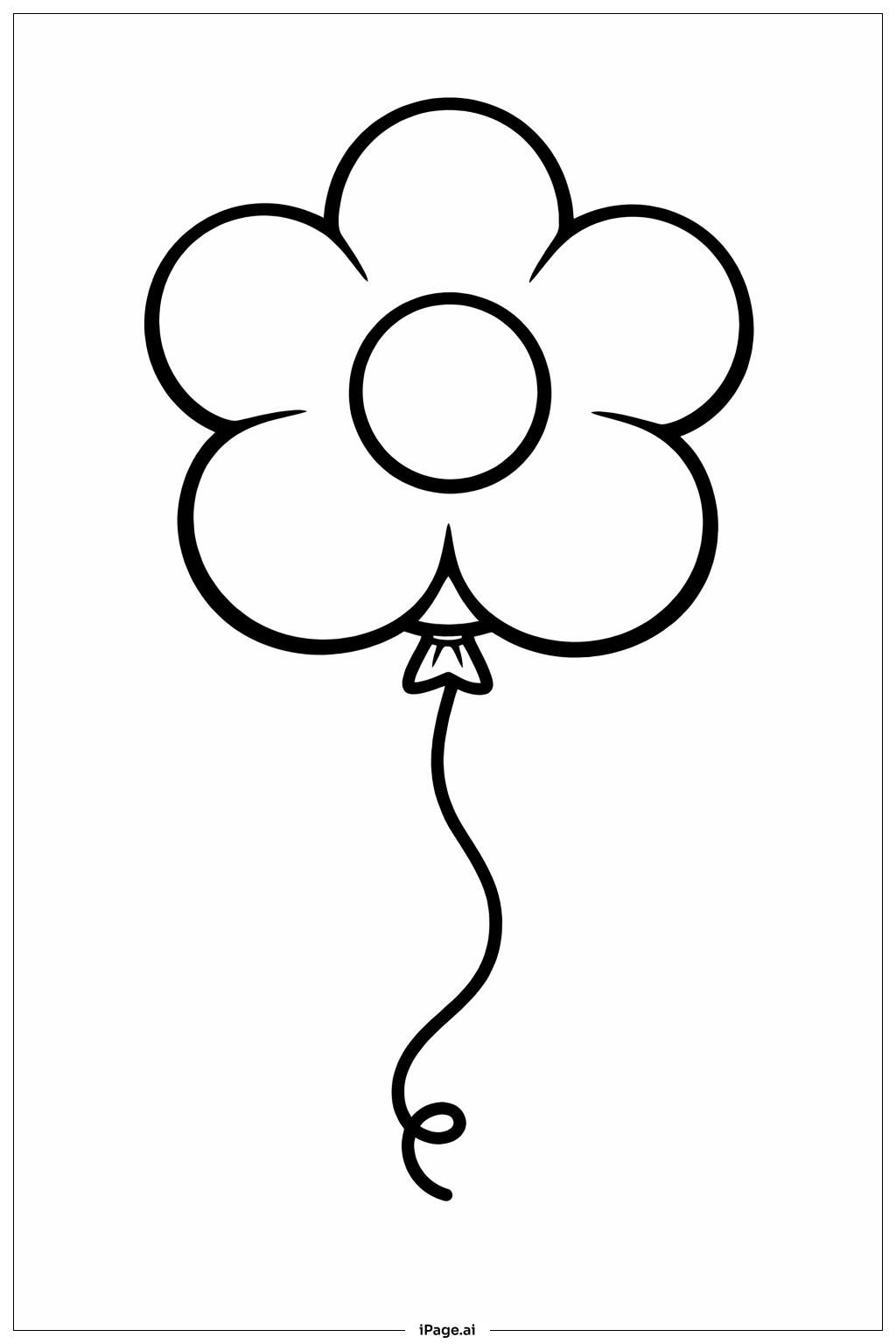
Coloring tips: How to color Balloon Flower coloring page well?
For a realistic approach, consider using various shades of purple and blue for the petals, as balloon flowers naturally bloom in these cool tones. You could also try pink, violet, or even white variations. The center stamens work beautifully in yellow or golden hues with darker accents. For the leaves and stem, explore different greens from lime to forest green, adding darker tones along the veins to create depth. Try blending lighter and darker shades on each petal to give dimension, making the outer edges slightly darker than the centers. The stem could transition from a lighter green at the top to a deeper green toward the base. Don't forget to add subtle shadows beneath the flower head and where leaves meet the stem to make your artwork pop off the page.
Coloring challenges: Which parts are difficult to color and need attention for Balloon Flower coloring page?
• Petal Shading and Dimension: The five rounded petals require careful color blending to create a three-dimensional effect. Each petal needs to show curvature, which means applying lighter colors in the center and gradually deepening the tone toward the edges. Young colorists may find it challenging to maintain consistent shading across all five petals while keeping the star-like symmetry intact. The overlapping areas where petals meet require special attention to create realistic shadows.
• Intricate Center Details: The flower's reproductive structures in the center contain fine lines and small spaces that demand precision and patience. Coloring the delicate stamens and pistil without bleeding into adjacent areas or leaving white gaps requires steady hand control. The tiny anthers at the stamen tips need careful color application, and distinguishing these small elements from one another presents a fine motor skill challenge for younger children.
• Leaf Veining Patterns: The elongated leaves feature detailed vein structures that run throughout each leaf blade. Coloring along these thin lines while maintaining distinct colors for the veins versus the leaf body requires careful technique. Children must decide whether to color over the veins or around them, and creating natural-looking variation in the leaf color while respecting these linear patterns demands planning and control.
• Stem Continuity and Leaf Attachment: Maintaining consistent color and shading along the stem while working around the attached leaves presents a spatial challenge. The areas where leaves connect to the stem require attention to create natural-looking joints and shadows. Keeping the stem's cylindrical form visible through appropriate shading while navigating multiple leaf insertions tests a colorist's ability to visualize three-dimensional structures.
Benefits of coloring books: Advantages of drawing Balloon Flower coloring page
Coloring this balloon flower offers wonderful developmental benefits for children. The distinct petal sections help young artists practice staying within boundaries, improving fine motor control and hand-eye coordination. The symmetrical five-petal design naturally introduces concepts of pattern recognition and geometric balance. Working with the detailed center structures enhances focus and concentration as children navigate small, intricate spaces. The leaf veining provides excellent practice for creating texture and understanding botanical structures, fostering an appreciation for nature's patterns. This image encourages color theory exploration as children experiment with complementary colors for flowers and foliage. The varying complexity levels mean children can approach it simply with solid colors or challenge themselves with shading and blending techniques. Completing this detailed flower builds confidence, patience, and a sense of artistic accomplishment while providing a calming, meditative activity that reduces stress and promotes mindfulness.