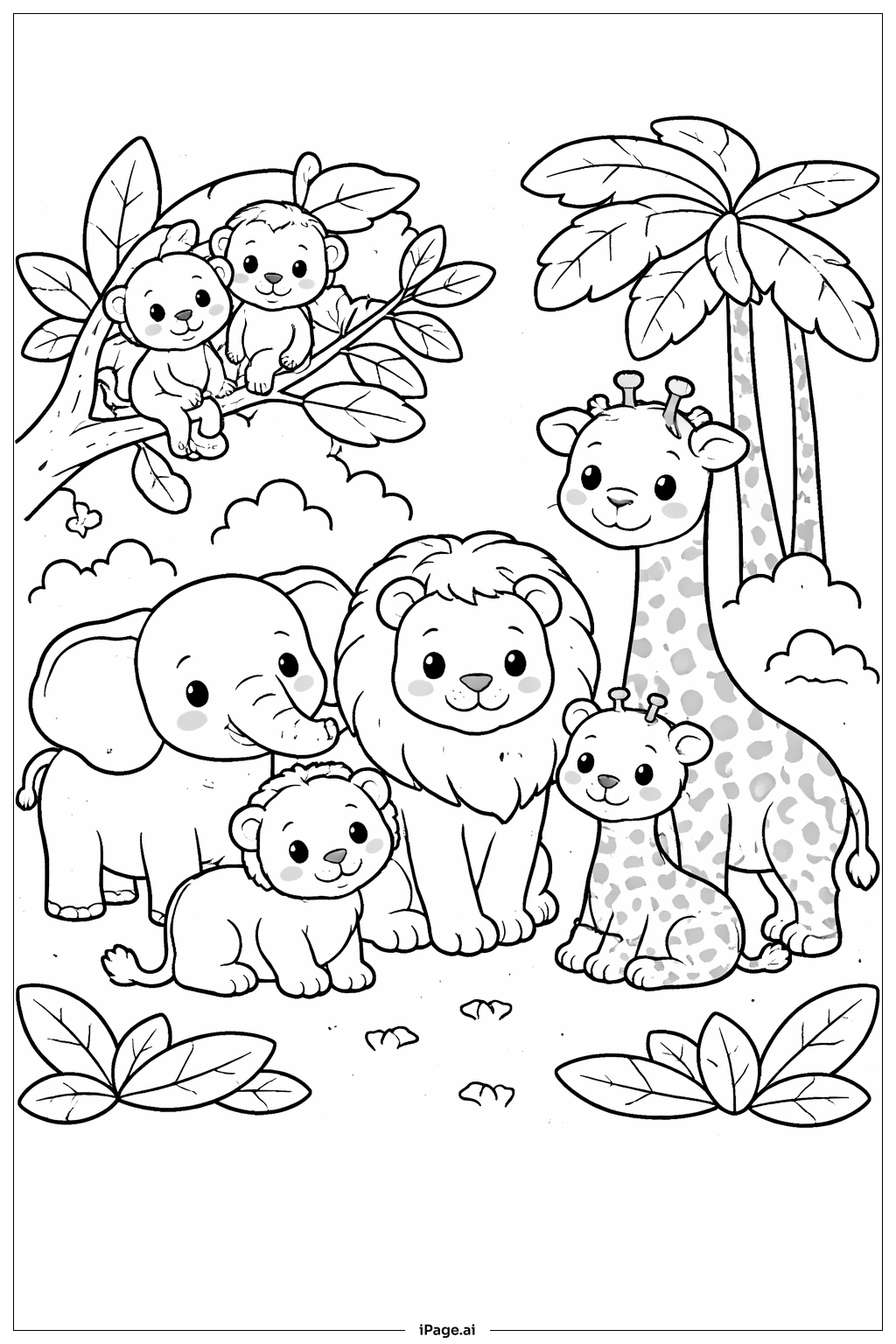
Coloring tips: How to color Jungle Animal Family coloring page well?
Start with the lightest colors first and work your way to the darker ones. Use warm grays and soft browns for the elephant, and bright yellows with orange patches for the giraffe. Give the lion a golden mane and a tawny coat. Use bold black and white stripes for the zebra, and a mix of warm browns and tans for the monkey. For the jungle background, choose vibrant greens for the leaves and trees. Add pops of color with tropical flowers in red, pink, yellow, and purple. Try blending two shades of the same color to give each animal a more lifelike, three-dimensional look. Use a lighter tone for the belly areas and a deeper shade along the edges. Encourage kids to use their imagination freely — there are no wrong color choices in the jungle! For a fun twist, try coloring the scene at sunset using warm oranges, pinks, and purples in the background sky.
Coloring challenges: Which parts are difficult to color and need attention for Jungle Animal Family coloring page?
• Overlapping Animal Figures: Several animals are positioned close together, which makes it easy to accidentally color outside the lines into a neighboring animal's area. Take extra care near the borders between characters, and use a fine-tipped marker or colored pencil to outline each animal before filling in the larger areas.
• Complex Jungle Background: The dense leaves, branches, and flowers in the background create many small, irregular shapes that can be tricky to color neatly. Work slowly and use the tip of your coloring tool to fill tight corners. Choosing different shades of green for individual leaves helps separate them visually without needing hard outlines.
• Animal Texture and Patterns: Each animal has its own distinct texture or pattern — the zebra's stripes, the giraffe's patches, the lion's mane, and the elephant's wrinkled skin all require different techniques. Coloring the giraffe's patches and zebra's stripes accurately without going over the border lines demands patience and a steady hand.
• Shading and Depth: Creating a sense of volume on large, smooth-surfaced animals like the elephant is challenging for younger colorists. Applying two tones of the same color — one lighter for highlighted areas and one darker for shadowed areas — takes practice but greatly improves the final result.
• Small Decorative Details: Flowers, leaves, and small facial features like eyes and nostrils are tiny and require precise coloring. Using a sharp pencil tip or a fine liner before applying broader color can help keep these details clean and defined.
Benefits of coloring books: Advantages of drawing Jungle Animal Family coloring page
Coloring this jungle animal family scene offers a wide range of benefits for children and beginners alike. First, it builds fine motor skills. Staying within the lines and handling coloring tools trains hand-eye coordination and strengthens the small muscles in the fingers and wrists, which are important for writing and other daily tasks. Second, it sparks creativity. Choosing colors for each animal and the jungle background encourages kids to make their own artistic decisions and express their unique personality through color. Third, it teaches focus and patience. The scene has many detailed areas that require careful attention, helping children practice concentration and the ability to slow down and work through a task step by step. Fourth, it introduces children to the natural world. Recognizing animals like elephants, giraffes, lions, and monkeys in their jungle habitat builds early awareness of wildlife and nature. This can inspire curiosity and a love for animals. Finally, completing the page gives children a real sense of accomplishment and pride, boosting their self-confidence. Coloring is also a calming, screen-free activity that helps reduce stress and anxiety, making it a wonderful creative outlet for kids of all ages.